

Just until recently, having AI join your calls to transcribe them and actually be impressed with the result felt like the stuff of science fiction. Now, all teams use some form of AI transcription in their day-to-day work.
This article will not only be useful for those of us asking what AI transcription is, but also for those who want to understand how this technology actually works and how they can use AI to transcribe audio, video, and live meetings more efficiently than ever before.
What is AI transcription?

AI transcription is a tool that listens to speech and turns it into text. You can use it while people are speaking or after you upload a recording.
If you are asking what AI transcription is, especially in a meeting, think of it as a speech-to-text tool. It writes down the conversation for you, and everything said during it while you focus on the people in the meeting or on the call.
The written file is called an AI transcript. It may include:
- Everything written down that was said during the call
- Names or labels for each speaker
- Timestamps that show when something was said
- A short summary of everything discussed
- Tasks and next steps
- Key points from the call
For instance, your team can record your daily meeting where you discuss what you will work on during the day. Afterward, you can go and search the AI transcript for certain keywords like “launch date” or “budget” instead of listening to the whole meeting again. This is useful because for many people, reading is faster than scrubbing through an actual recording.
An AI assistant can also use the transcript to help with context. Notes, summaries, and follow-up tasks fed to your assistant make it more helpful, and it frees up time for you. This gives your team more time to talk, listen, and make decisions.
Now that you know what AI transcription means, let’s look at the main types.
Types of AI transcription
AI transcription can work in a few different ways. The right type to use depends on when you need the text and what kind of recording you have of the meeting.
Live transcription
Live transcription writes down speech as people talk. It is useful for online meetings, classes, webinars, and events.
People can read along during the call. It can also help someone catch up if they join late.
Recorded transcription
Recorded transcription works after a call, interview, or video ends. You upload the file, and the tool writes out the text.
You can use it to transcribe video to text for tutorials, product demos, and other recordings.
Speaker labels
Some tools can tell speakers apart. They add labels so you can see who said what during the conversation.
For example:
“Sam: I will send the draft on Friday.
Tom: Great. I will look it over before the client call.“
This is especially helpful in meetings and interviews. Still, check the labels if people speak at the same time or have similar voices.
Full and cleaned-up transcripts
A full transcript tries to write down every word, including pauses and words like “um” or “uh.” A cleaned-up transcript, on the other hand, takes out some of those extra words. It is often easier to read this kind of transcript and works well for meeting notes and content work.
Some tools can also help with things like songs or even music, which would be AI that can transcribe music.
Each type of transcription can save time. Next, let’s break down how AI turns sound into text.
How AI transcription works
AI transcription listens to speech and matches sounds with written words. It also looks at the words around them to make a better guess about what was said.
Here is how it works:
- You start a live recording or upload an audio or video file.
- The tool listens to the speech.
- It breaks the speech into small parts.
- AI matches those sounds with words.
- It adds punctuation, paragraphs, timestamps, and speaker labels.
- It creates an AI transcript you can read, edit, and share.
The tech behind AI transcription
AI transcription uses a few types of technology that work together to turn speech into useful text.
- Automated Speech Recognition: ASR is the part that listens to an audio file or live call and turns spoken sounds into words.
- Natural Language Processing: NLP helps the tool understand the words around each other.
- Large Language Models: LLMs can help turn a raw AI transcript into something easier to use. They can create summaries, pull out action items, and point to key topics from the conversation.
Together, these tools do more than just write down a conversation. They help turn spoken information into text that is easier to read, search, and use. If you want to learn more, read our article on how AI works.
When someone says, “Please write the recap.” The word “write” sounds like “right,” but the rest of the sentence helps the tool pick the correct word through prediction.
AI can get a lot right, but it can still make mistakes. Names, dates, numbers, strong accents, background noise, and people talking over each other can trip it up.
The transcript is only the start. Many tools also come with features that help you get more from each call.
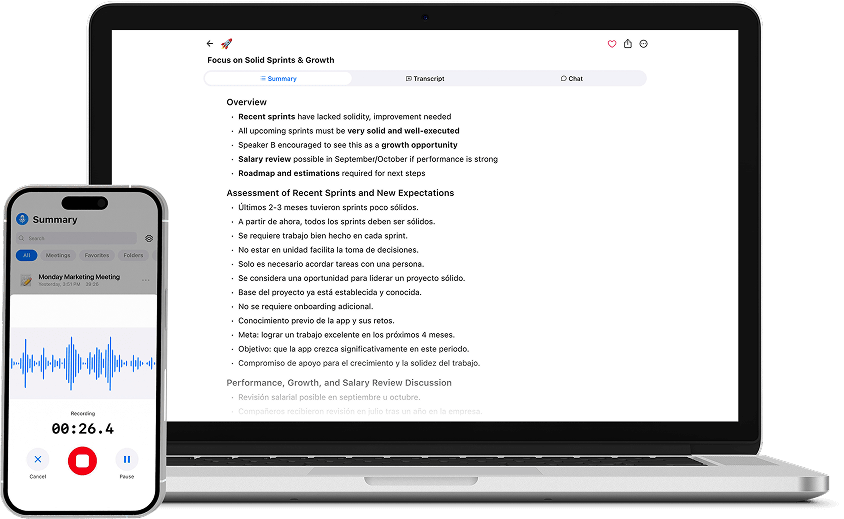
Platforms like Summary AI use AI transcripts to make a summary of your meeting and calls.
AI Transcription Features
AI transcription tools often do more than write down words. They can help you sort through the conversation and find what matters.
Common features include:
- Speaker labels: Show who said what
- Timestamps: Help you jump to the right part of a recording
- Search: Help you find a word, topic, or quote
- Summaries: Give you the main points of the transcript
- Action items: Pull out tasks, owners, and due dates
- Captions: Add text to videos
- Editing: Let you fix errors before sharing
- Exports: Let you save the text or send it to other tools
A free audio-to-text transcription tool can be a good way to try AI transcription before you pay for it. Look at the time limit, language choices, and editing options before you choose one.
These features are useful because they make the transcript easier to act on. Here are some common ways people use them.
Common Uses of AI transcription

AI transcription can help many kinds of teams. It gives people a written record without making someone type notes the whole time.
Here are a few common uses:
- Meetings: Keep track of decisions, tasks, and next steps
- Sales calls: Save customer questions, needs, and follow-ups
- Interviews: Help recruiters, writers, and researchers look back at answers
- Podcasts: Turn episodes into show notes, captions, and blog ideas
- Videos: Make captions and written notes for viewers
- Classes: Give students a written version of a lesson
- Training: Turn recorded sessions into guides
Marketing teams can use transcripts to pick up the words customers use. They can then use those ideas in emails, campaigns, and marketing automation. Content teams can pull out questions, quotes, and topics from calls. This can help them plan content using AI marketing tools without starting from scratch each time. Support teams can review customer calls to improve scripts, training, and conversational AI.
These uses show why AI transcription can be so helpful. The biggest gains often come from time saved and clearer notes.
Benefits of AI transcription
AI transcription can help you spend less time on manual notes and more time on the work that comes next. Here are some key benefits:
- Saves time: The tool writes notes while you focus on the conversation.
- Makes calls easier to review: You can search the text instead of replaying a long recording.
- Keeps teams on the same page: Everyone can check what was agreed.
- Helps people catch up: Anyone who misses a meeting can read the notes later.
- Makes content easier to reuse: You can transcribe audio to text and turn one recording into posts, captions, show notes, and articles.
- Helps more people follow along: Transcripts and captions can support people who need written text.
- Cuts down work: You do not need to type up every call by hand.
- Makes information easier to find: You can search past calls for key details.
AI transcription can make work easier, but it is not always perfect. Before you use it for every call, it helps to know where it can fall short.
Risks and limits to know
AI transcription can get things wrong. It works best when you check the text before you share it or use it to make a big decision. Keep these points in mind:
- It can miss words: Background noise and strong accents can lead to mistakes.
- It can mix up speakers: This can happen when people talk over each other.
- It can get names and numbers wrong: Always check key details.
- Private data needs care: Know where your recordings and transcripts are kept.
- People should know about recordings: Tell attendees when a call is being recorded or transcribed.
- Some info needs a human check: Legal, medical, hiring, and money-related records should not rely only on AI text.
Think of AI transcription as a strong first draft. It can do a lot of the work, but you should still look over the final version.
How to use AI transcription

Getting started with AI transcription is simple. Most tools follow the same basic steps. There are many AI platforms that offer transcription. Choose one based on what you need, such as meeting notes, video captions, language support, sharing tools, or privacy.
Here is a simple way to use it:
- Choose a live meeting or an audio or video file.
- Connect your meeting tool or upload the recording.
- Pick the spoken language.
- Start the transcription.
- Wait for the AI transcript to be ready.
- Read through the text and fix key mistakes.
- Check the summary and action items.
- Share the transcript with the right people.
You can get better results by using a good microphone and recording in a quiet place. Ask people to speak one at a time when they can. This works for many types of recordings. It is especially useful for meetings, where notes can get lost quickly.
AI transcription for meetings
Meetings can move fast. When people try to take meeting notes, answer questions, and share ideas at the same time, it is easy to miss something.
Summary AI’s AI transcription can write down the conversation while the meeting happens. This helps everyone stay focused on the talk instead of looking down at their notes.
Using AI transcription for meetings can help teams:
- Keep track of decisions
- Pull out tasks and task owners
- Share updates with people who missed the call
- Find customer feedback from past meetings
- Look back at key parts of a recording
- Build a clear record of project work
For example, after a team meeting, you can check the transcript to see who owns the landing page, when the draft is due, and when the next review call will take place.